
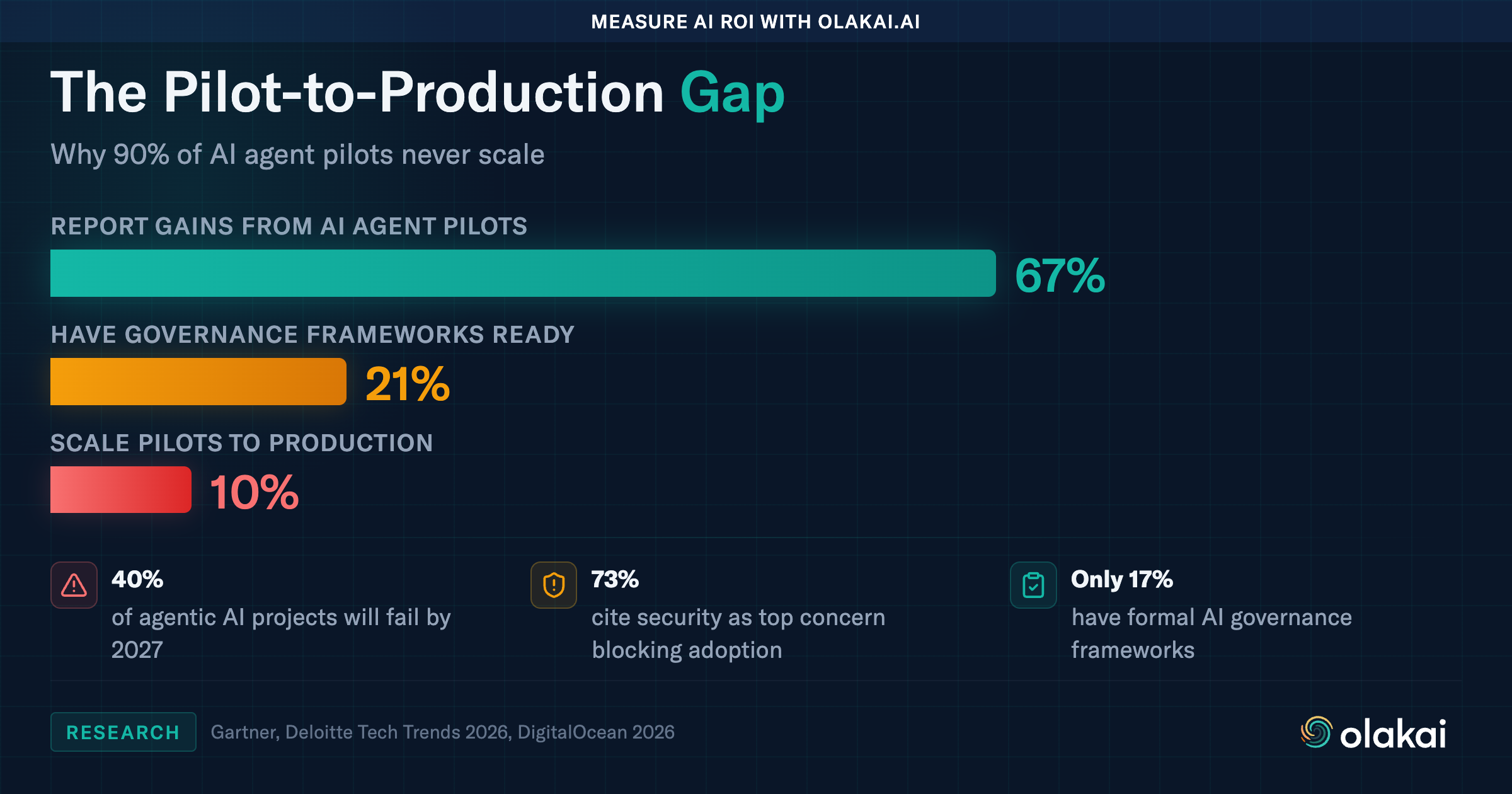
Gartner projects that 40% of agentic AI projects will be canceled or abandoned by 2027. That number should make any enterprise leader pause — but not for the reason you think.
The failures won't come from technology limitations. They'll come from deployment strategy. The enterprises that succeed with agentic AI don't start with the most sophisticated agents or the biggest budgets. They start with the right use case, the right guardrails, and a clear definition of what "done" looks like before writing a single line of code.
The Deployment Paradox
The data tells a contradictory story. According to DigitalOcean's 2026 research, 67% of organizations report measurable gains from AI agent pilots. But only 10% successfully scale those pilots to production. That's not a technology gap — it's an execution gap.
Three patterns emerge from failed deployments. First, teams start with autonomy instead of assistance — giving agents too much decision-making freedom before establishing trust boundaries. Second, nobody defines success criteria before launch, which means there's no way to prove value when the CFO asks. Third, governance gets treated as an afterthought. Deloitte's 2026 Tech Trends report found that only 21% of enterprises have governance frameworks ready for agentic systems. The rest are building the plane while flying it.
The question isn't whether agents can work. It's whether you can deploy them in a way that sticks.
Step 1: Select the Right First Use Case
Not all use cases are equal for a first deployment. The ideal first agent sits at the intersection of four criteria: high volume, low risk, clear metrics, and contained blast radius.
High volume means the task happens frequently enough to generate meaningful data within weeks, not quarters. Low risk means errors are catchable and reversible — think internal document routing, not customer-facing financial decisions. Clear metrics means you can define a before-and-after comparison: time saved, accuracy improved, cost per transaction reduced. And contained blast radius means starting with internal workflows before exposing agents to customers or partners.
The anti-pattern here is starting with the CEO's pet project. Executive enthusiasm is valuable, but the first agent deployment needs to be one where you can measure impact against a well-understood baseline. Invoice processing, IT ticket triage, internal knowledge retrieval — these aren't glamorous, but they're the proving grounds where first agents succeed.
If you're looking for inspiration, browse the 114 enterprise use cases ranked by complexity and expected ROI. The best first candidates are in the "high frequency, low autonomy" quadrant.
Step 2: Define KPIs Before You Build
The number one reason AI pilots die in committee is that nobody defined what success looks like before day one. McKinsey's State of AI report found that only 17% of organizations have formal governance structures for AI projects — and KPI definition is the first casualty of that gap.
For your first agent, you need four KPI categories locked in before development begins. An efficiency KPI measures time or cost reduction against the manual baseline. A quality KPI tracks accuracy, error rates, or customer satisfaction deltas. An adoption KPI monitors whether humans are actually using the agent or routing around it. And a cost KPI captures the full picture — inference costs, infrastructure overhead, and maintenance burden.
The trap is measuring only what's easy. Inference cost per query is simple to track, but it tells you nothing about business value. The agents that survive budget reviews are the ones whose sponsors can say "this agent saved 340 hours of analyst time last quarter" — not "this agent processed 50,000 tokens at $0.002 each." See the complete KPI library for agentic AI to build your measurement framework before writing any code.
Step 3: Governance First, Not Governance Later
Here's the uncomfortable truth: the organizations building governance after deployment are the ones showing up in the 40% failure statistic. EY's CIO Playbook found that security (73%) and data privacy (73%) are the top concerns blocking enterprise AI adoption. Those concerns don't go away just because your pilot is working — they intensify as you try to scale.
For your first agent, governance means four concrete decisions. Decision boundaries define what the agent can decide alone versus what requires human approval. An audit trail ensures every action is logged and traceable — not for compliance theater, but because you'll need this data to improve the agent and defend its decisions. Human-in-the-loop triggers set explicit escalation criteria upfront, before the agent encounters an edge case in production. And data access controls enforce least privilege from day one, not after the first security incident.
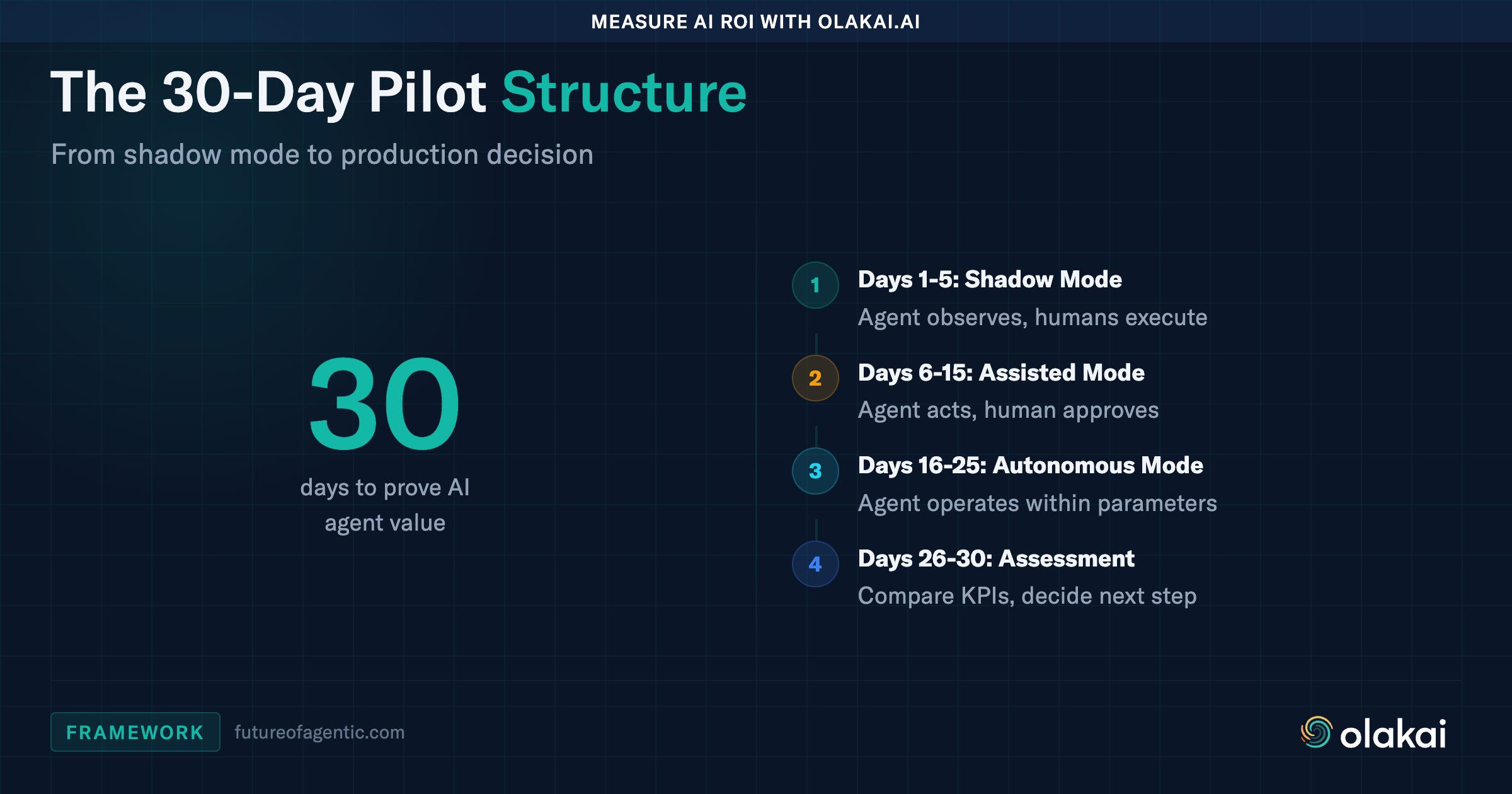
The deployment model that works is a three-stage progression: shadow mode, where the agent observes and recommends but humans execute; assisted mode, where the agent acts but a human approves each action; and autonomous mode, where the agent operates within defined parameters. Don't skip stages. Each one builds the trust data and governance muscle you need for the next. Explore the full governance framework for autonomous AI systems to build your guardrails before your agent goes live.
Step 4: The 30-Day Pilot Structure
Abstract timelines kill pilots. Here's a concrete structure that forces clarity at every stage.
Days 1 through 5 are shadow mode. The agent observes real workflows, generates recommendations, but takes no action. Humans execute every task while the agent watches. This phase validates that the agent understands the domain and generates useful outputs — without any risk. If the agent's recommendations are wrong more than 30% of the time, stop here and retrain before proceeding.
Days 6 through 15 are assisted mode. The agent begins acting, but every action requires human approval. This is where you discover edge cases, refine decision boundaries, and build the audit trail that will inform governance. Track approval rates — if humans are rubber-stamping 95% of actions, you're ready to progress. If they're overriding 40%, you have a quality problem to solve first.
Days 16 through 25 are autonomous mode. The agent operates within the parameters you've defined, escalating only when it hits boundaries. This is the real test. Monitor KPIs against your baseline daily, not weekly. Watch for drift — agents that perform well in week one can degrade as they encounter distribution shifts in real data.
Days 26 through 30 are assessment. Compare every KPI to your pre-deployment baseline. Document what worked, what broke, and what surprised you. This assessment is the artifact that determines what happens next. For a structured approach to this timeline, see the 90-day roadmap for agentic AI deployment.
Step 5: The Scale Decision
After 30 days, you have data. Use it ruthlessly. Scale if KPIs exceed baseline by more than 15% and governance held — meaning no unresolved escalations, no data access violations, no shadow workarounds by users. Fix if KPIs improved but governance gaps surfaced — address the gaps, tighten the boundaries, and run another 15-day cycle. Kill if KPIs are flat or negative after a genuine 30-day effort — reallocate the team to a different use case rather than sinking more time into a deployment that isn't proving value.
Before scaling, calculate the full economics. A pilot that saves $50,000 per quarter in one department might cost $200,000 per quarter to run across ten departments if infrastructure doesn't scale linearly. Run the economics calculation before committing to enterprise-wide rollout.
The Bigger Picture
Your first agent isn't the goal — it's the proof point. Enterprises that succeed at agentic AI don't go from zero to fifty agents. They go from zero to one, prove value with hard numbers, build institutional muscle around governance and measurement, then scale methodically.
The agentic AI market is projected to grow from $7.8 billion to $52 billion by 2030. The opportunity is real. The 40% failure rate is also real. The difference between the two outcomes isn't budget or technology — it's whether you deployed with a plan or deployed with hope.
If you're ready to deploy your first agent with the measurement and governance infrastructure to prove its value, see how Olakai helps enterprises measure AI ROI from day one.